Part 107 test changes, October 2026: new chart questions explained
Updated 2026-10-16. Independent guide, not affiliated with the FAA.
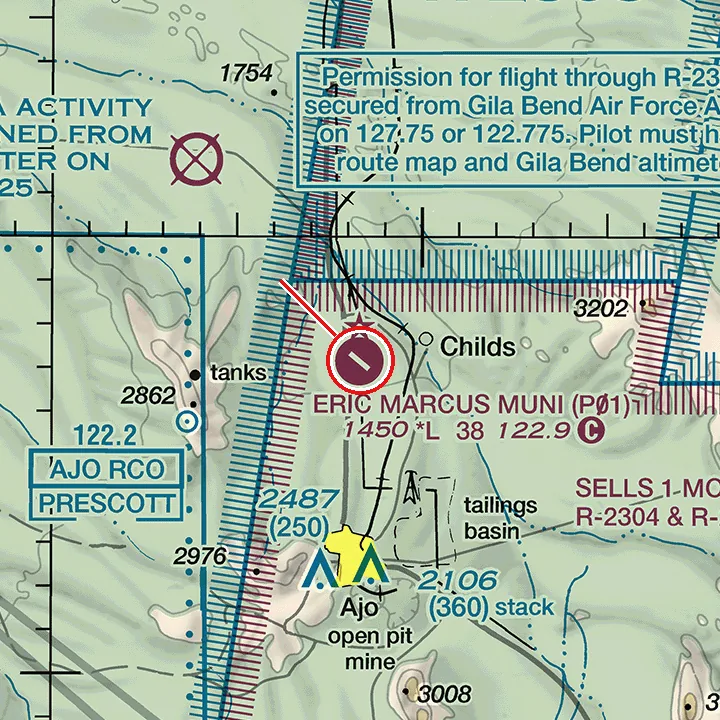
Short version: starting October 26, 2026, the FAA's Part 107 knowledge test (officially Unmanned Aircraft General - Small, test code UAG) will include image-based questions that are not in the printed testing supplement. The images are excerpts from FAA sectional charts. You cannot study them in advance, so you need to be able to read any sectional, not just the figures in the supplement.
Primary source: FAA Airman Testing Community Advisory (ATCA), September 2026 Special Edition, pages 5 and 9-10. The same text appears in the August 2026 ATCA. Checked October 16, 2026.
What the FAA said, word for word
The advisory states: "Beginning October 26, 2026, the Instrument Rating Airplane (IRA) and Unmanned Aircraft General-Small (UAG) tests will include image-based questions not found in the test supplements." It adds that the update "enhances the tests by incorporating clearer, up-to-date images from the latest Sectional Charts, Instrument Approach Charts, and Low Altitude Enroute Charts," sourced from FAA VFR charts and IFR low altitude charts.
For Part 107, that means sectional chart excerpts embedded directly in the question on screen.
Key facts at a glance
- Effective date: October 26, 2026. The June 2026 advisory said October 27; the August and September editions mark October 26 as a corrected date.
- Which test: Unmanned Aircraft General - Small (UAG), the initial Part 107 Remote Pilot knowledge test taken at PSI testing centers. (The Instrument Rating Airplane test changes the same day.)
- What is new: image questions whose chart excerpts are not in the testing supplement (FAA-CT-8080-2H).
- Can you preview the images? No. The FAA says images embedded in active questions "cannot be previewed, as doing so would compromise the exam's integrity."
- Is the supplement going away? Not yet. The FAA says the removal date "has not yet been set," that the public will get "ample notice," and that until then candidates keep access to the supplement.
- Measuring tools: the FAA says some questions may need measuring tools, applicants will get the tools they need, and new on-screen tools will be announced in advance in the advisory.
- Format, length and passing score: the advisories announce no change. Per the Remote Pilot ACS (FAA-S-ACS-10B), the test is 60 multiple-choice questions, up to 2 hours, 70% to pass.
The two Part 107 sample questions the FAA published
The advisory includes two UAG samples, each with a small sectional excerpt and a caption naming the chart and its dates:
- Millville Muni (MIV), Washington sectional. Asks what type of airspace is associated with the airport and whether ATC authorization is required for a small UA. The FAA's answer: Class E associated with an airport surface area, and authorization is required. On the chart, that is the dashed magenta line around the airport.
- Grand Canyon National Park (GCN), Las Vegas sectional. Asks which frequency to use as the CTAF when the control tower is not in operation. The FAA's answer: 119.0, the tower frequency, which is marked with a star (part-time tower) and a C (becomes the CTAF). The wrong choices are other frequencies printed nearby (ATIS and UNICOM).
Notice what these test: legend knowledge applied to a chart you have never seen. Neither one can be answered by remembering a supplement figure number.
One nuance most summaries miss
Both FAA samples are captioned with a sectional "dated 12 JUN 2025 to 7 AUG 2025." So "latest" means recent chart editions at the time the question was written, not necessarily the edition in effect on your test day. Practically: expect real, current-looking sectional excerpts of places you have probably never studied, and expect the same symbols as the legend. Train on unseen excerpts.
Who this affects most
The UAG test is the FAA's highest-volume knowledge test: 73,914 tests in calendar year 2025, with an 82.96% pass rate and a 79.31% average score. Roughly one in six applicants already fails. Applicants who memorized the supplement's chart figures (Figures 20-26 and the sectional legend) lose a shortcut; those who can read a chart lose nothing.
How to prepare for the new chart questions
- Learn the legend by topic, not figure by figure: airspace boundaries and altitudes, airport data blocks, obstacles (MSL vs AGL), special use airspace, latitude and longitude.
- Drill on unseen excerpts. Our free diagnostic uses 10 excerpts from current FAA sectionals. It takes about 5 minutes.
- Use your own area's chart. Sectionals are free from the FAA VFR charts page. For five airports near you, write down the surface airspace, any Class D ceiling, the CTAF, field elevation and the tallest nearby obstacle.
- Do the free daily chart question. Today's chart question: one FAA sectional excerpt, one question and a worked answer, new every day, no account. (The test uses recent excerpts you have not seen, not necessarily today's edition.)
- Still study the supplement. It remains at the test center for questions that use it.
- Take timed 60-question mocks and aim for 80%+ before booking.
Try 10 chart questions free
Excerpts from current FAA sectionals, worked explanations, score by topic. About 5 minutes, no signup.
Take the free 10-question chart diagnosticWhat has not changed
The knowledge areas are the same Remote Pilot ACS areas: Regulations (15-25%), Airspace and Requirements (15-25%), Weather (11-16%), Loading and Performance (7-11%) and Operations (35-45%). Retesting after a failure still requires waiting 14 calendar days.
Sources
- FAA ATCA September 2026 Special Edition: https://www.faa.gov/training_testing/testing/September_2026_Special_Edition.pdf
- FAA ATCA August 2026: https://www.faa.gov/training_testing/testing/August_2026_ATCA.pdf
- FAA ATCA June 2026 (original October 27 date): https://www.faa.gov/training_testing/testing/June_2026_Edition.pdf
- Remote Pilot ACS, FAA-S-ACS-10B: https://www.faa.gov/training_testing/testing/acs/uas_acs.pdf
- FAA CY2025 Airman Knowledge Test volume report: https://www.faa.gov/data_research/aviation_data_statistics/test_statistics/CY2025_AKT_Volume_Report.pdf
- FAA VFR raster charts: https://www.faa.gov/air_traffic/flight_info/aeronav/digital_products/vfr/
FAQ
- When do the new Part 107 chart questions start?
- October 26, 2026, per the FAA's August and September 2026 Airman Testing Community Advisories. An earlier June edition said October 27; the FAA corrected it.
- Will the testing supplement still be available?
- Yes, for now. The FAA says the removal date has not been set and the public will get ample notice.
- Can I see the new chart images before the test?
- No. The FAA says images in active questions cannot be previewed. Practice on unseen sectional excerpts instead.
- Did the passing score or number of questions change?
- No change was announced. The test is 60 questions, up to 2 hours, and 70% is required to pass.
Full access
$24 one-time. No subscription.
The FAA test costs about $175 at the testing center, and a fail means a 14-day wait to retest.
- 178 chart questions on excerpts from current FAA sectionals, each with a worked explanation
- 304 general Part 107 questions mapped to Remote Pilot ACS codes
- Timed 60-question mock exams in the FAA test format (2 hours, 70% to pass)
- Read the current chart mode: unseen chart excerpts, timed
- Spaced repetition review that remembers what you miss
- No account, no subscription, works on your phone
- No account
- Works on your phone
- Instant access
SectionalDrill is independent and not affiliated with the FAA, the U.S. government or any government agency.